

Turkmenistan 10 MT Broiler Premix Project: How a 2.5% Ross 308 Feeding Solution Works
Factory-Direct Poultry Premixes | Customized Local Feed Formulations | New Hope Liuhe
One Question from Turkmenistan. A Complete Broiler Nutrition Discussion.
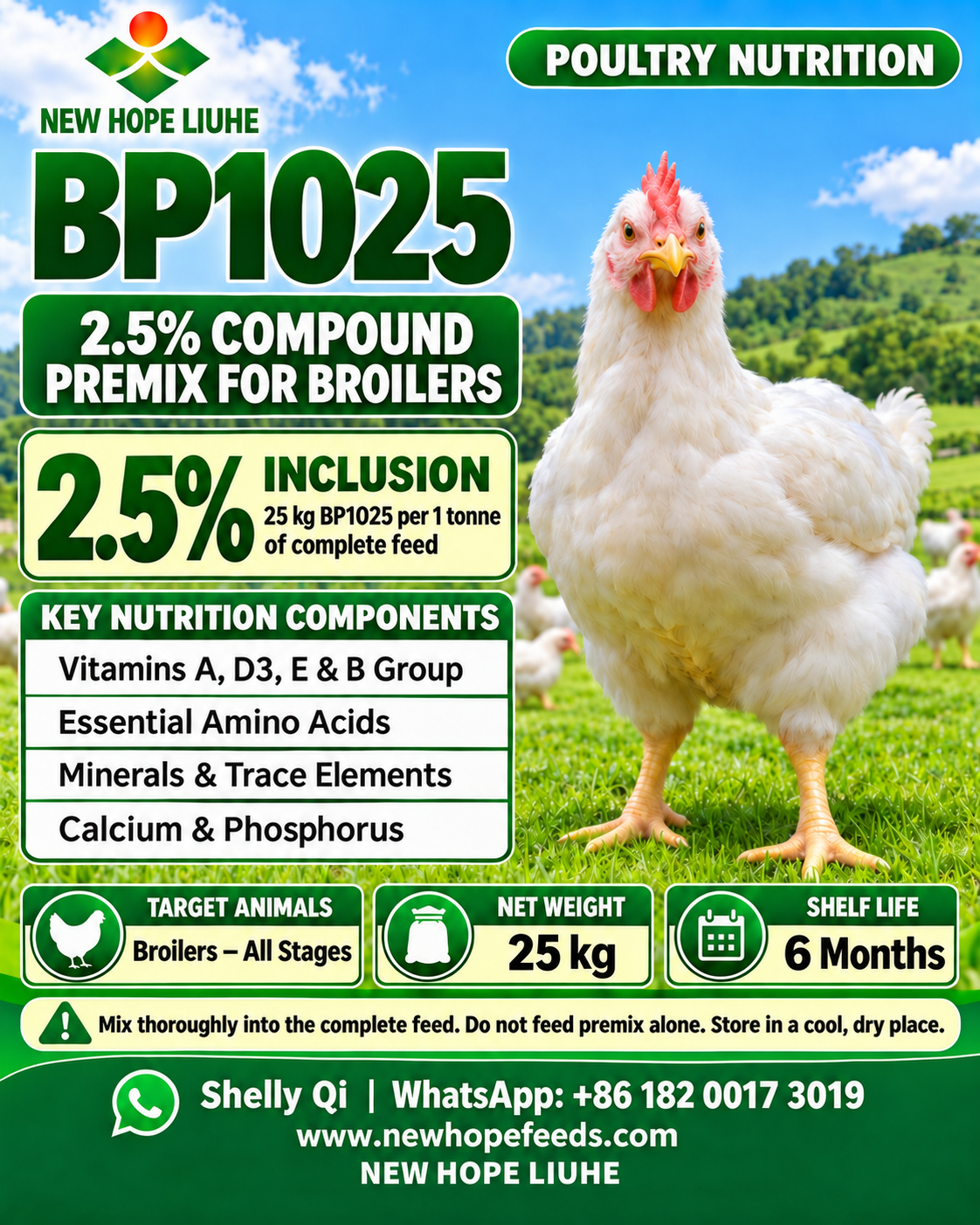
When a poultry producer asks us about 10 metric tons of 2.5% broiler premix for Ross 308 chickens, the conversation goes beyond the price per bag.
The important questions are practical: What exactly is a premix? How much should we add? Can we use the grain and protein meals available in our own market? And do growing chickens really need different formulas?
These are the questions behind New Hope Liuhe's Turkmenistan broiler premix project. Here is how our technical and international business teams explain the solution to feed mills and poultry producers.
“We raise Ross 308 broilers. Why do we need three premixes?”
New Hope Liuhe: Because the nutritional requirements of a day-old chick and a market-ready broiler are different. We work with three feeding stages:
| Premix | Feeding stage | Nutritional priority |
|---|---|---|
| BS — Broiler Starter | Early growth | Support early development with an appropriately balanced, nutrient-dense diet |
| BG — Broiler Grower | Rapid growth | Balance energy, digestible amino acids and minerals as feed intake increases |
| BF — Broiler Finisher | Final growth before marketing | Match nutrient supply to the finishing period and production goals |
The exact age boundaries depend on the flock's target market weight, feeding program and farm conditions. We do not apply one fixed phase schedule to every operation.
Published Ross broiler nutrition guidance also uses stage-specific nutrient specifications and recommends adjusting them for local circumstances. The purpose of BS, BG and BF is to help the finished feed meet the appropriate nutritional targets at each stage.
“What does 2.5% premix actually mean?”
New Hope Liuhe: It means the premix is included at 2.5% of the total weight of the finished feed.
For 1 metric ton (1,000 kg) of complete broiler feed:
| Ingredient group | Quantity |
|---|---|
| New Hope Liuhe 2.5% broiler premix | 25 kg |
| Other ingredients in the approved complete-feed formula | 975 kg |
| Total finished feed | 1,000 kg |
In other words, one 25 kg bag of a 2.5% premix is used for one metric ton of complete feed.
If a customer requires 10 MT (10,000 kg) of premix, that quantity can be used to produce approximately 400 MT of complete feed, assuming all premix is incorporated at the specified 2.5% rate and the corresponding approved formulas are followed.
Important: Premix is a concentrated feed ingredient, not a complete feed. Do not feed it directly to chickens. It must be accurately weighed and mixed into the complete-feed formula. The remaining 97.5% is not simply grain; it must supply the correct energy, protein, amino acids and other nutrients, including any macro-minerals and supplements required by the final formulation.
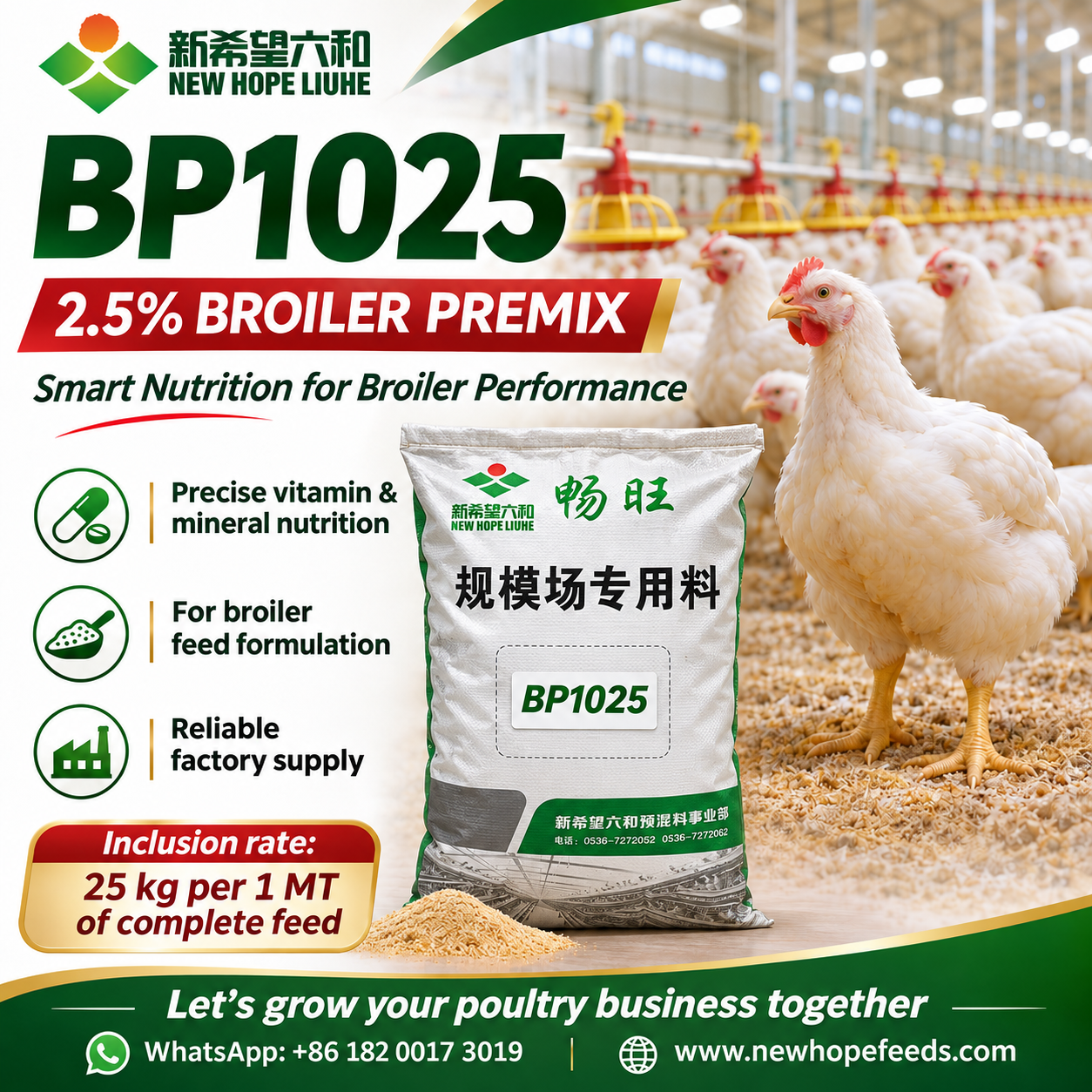
“Can we make the feed using ingredients available in Turkmenistan?”
New Hope Liuhe: Yes. In fact, local raw-material formulation is an important part of our technical service.
Rather than asking every customer to buy the same imported ingredients, we first look at what the feed mill can reliably source. Depending on availability, quality and nutritional suitability, these may include:
Energy sources: maize (corn), wheat, barley and approved vegetable oils.
Protein sources: soybean meal, sunflower meal and other suitable, tested protein ingredients.
Mineral sources and other components: limestone, feed phosphates, salt and additional ingredients selected by the nutritionist.
However, two batches of the same raw material may have different nutrient values. Wheat, barley and sunflower meal are not interchangeable kilogram for kilogram with maize or soybean meal. Each ingredient's actual composition and inclusion limits must be considered.
Our nutritionists can adjust the whole formula around the customer's local supply, with attention to metabolizable energy, digestible amino acids, calcium, available phosphorus, sodium, chloride and other essential nutrients. The final balance must reflect both the raw materials and the nutrients provided by the selected premix.
“What information do you need to customize our feed formula?”
New Hope Liuhe: Start with five things:
Bird type and production target: Ross 308, target market weight, expected slaughter age and production priorities.
Feeding phases: the ages or live-weight ranges used for Starter, Grower and Finisher.
Local raw-material list: names, current prices and quantities available throughout the production cycle.
Ingredient quality information: recent laboratory analyses, where available, including moisture, crude protein, fat, fiber and relevant mineral or amino-acid information.
Feed-mill and farm conditions: mixing equipment, pelleting process, climate, feed consumption and any known production challenges.
From there, we can discuss a stage-specific complete-feed formulation and select suitable premix specifications. Our goal is a practical combination of nutritional adequacy, ingredient availability and feed-cost control—not a formula that only looks good on paper.
“What nutrients are supplied by a broiler premix?”
New Hope Liuhe: A broiler premix can be designed to contribute a carefully controlled combination of vitamins, trace minerals and other specified nutritional components, according to its approved product specification.
For example, a broiler premix program may address vitamins A, D3, E and B-group vitamins, as well as trace minerals such as zinc, manganese and copper. Depending on the precise product, it may also contain certain amino acids or functional ingredients.
The key point is that a premix label does not replace a complete-feed formulation. The contribution of calcium, phosphorus, amino acids, salt and other nutrients must be checked against the actual specification. We never assume that every nutrient required by the birds is fully provided by a 2.5% inclusion alone.
“How should our feed mill mix the 2.5% premix?”
New Hope Liuhe: Accurate weighing and mixing are essential.
Weigh 25 kg of the correct BS, BG or BF premix for each 1,000 kg batch of finished feed.
Weigh the remaining ingredients according to the approved formula so that the total batch weight is exactly 1,000 kg.
Where appropriate for the mixer design, pre-blend the premix with a portion of a suitable carrier ingredient before adding it to the main mixer.
Follow the feed mill's validated mixing sequence and mixing time to achieve uniform distribution; verify mixer performance and avoid cross-contamination.
Store bags sealed in a cool, dry place, follow the label's shelf-life and storage instructions, and keep batch records for traceability.
Do not increase or decrease the 25 kg per ton inclusion rate, or add overlapping vitamin/mineral products, without a reviewed and approved reformulation.
“What does working with New Hope Liuhe look like?”
New Hope Liuhe: We see premix supply as a technical partnership. A typical project begins with a discussion of the flock, local ingredients and production goals, followed by specification review, formula development, quotation, manufacturing and ongoing technical communication.
For the Turkmenistan 10 MT premix requirement, the proposed three-stage approach is BS Starter, BG Grower and BF Finisher, each at a 2.5% inclusion rate. The quantity of each stage and the final formulas are confirmed against the customer's production plan and approved specifications.
Our international team is also available to discuss suitable packaging, factory-direct supply and future feed-formulation support.
Let's Build a Broiler Feed Formula Around Your Local Ingredients

“Can your team review our raw materials before we place an order?”
Absolutely. Share your raw-material list, ingredient prices, available analyses, Ross 308 feeding phases and target market weight. We can discuss a technically reviewed premix-and-complete-feed solution tailored to your feed mill.