

How Is an Egg Formed? Understanding Egg Formation and Nutrition in Laying Hens
How Is an Egg Actually Made Inside a Hen?
An egg may look simple from the outside, but its formation is one of the most highly coordinated biological processes in poultry production.
From the release of the yolk to the formation of albumen, shell membranes and the final eggshell, a laying hen must complete a complex sequence of physiological steps—usually within approximately 24 to 26 hours.
For commercial layer farms and feed mills, understanding this process is important because every stage depends on the bird receiving the right nutrients at the right time.
Balanced nutrition does not simply support the number of eggs produced. It also contributes to:
eggshell quality
egg weight and consistency
albumen quality
skeletal health
nutrient utilization
flock condition
persistence of lay
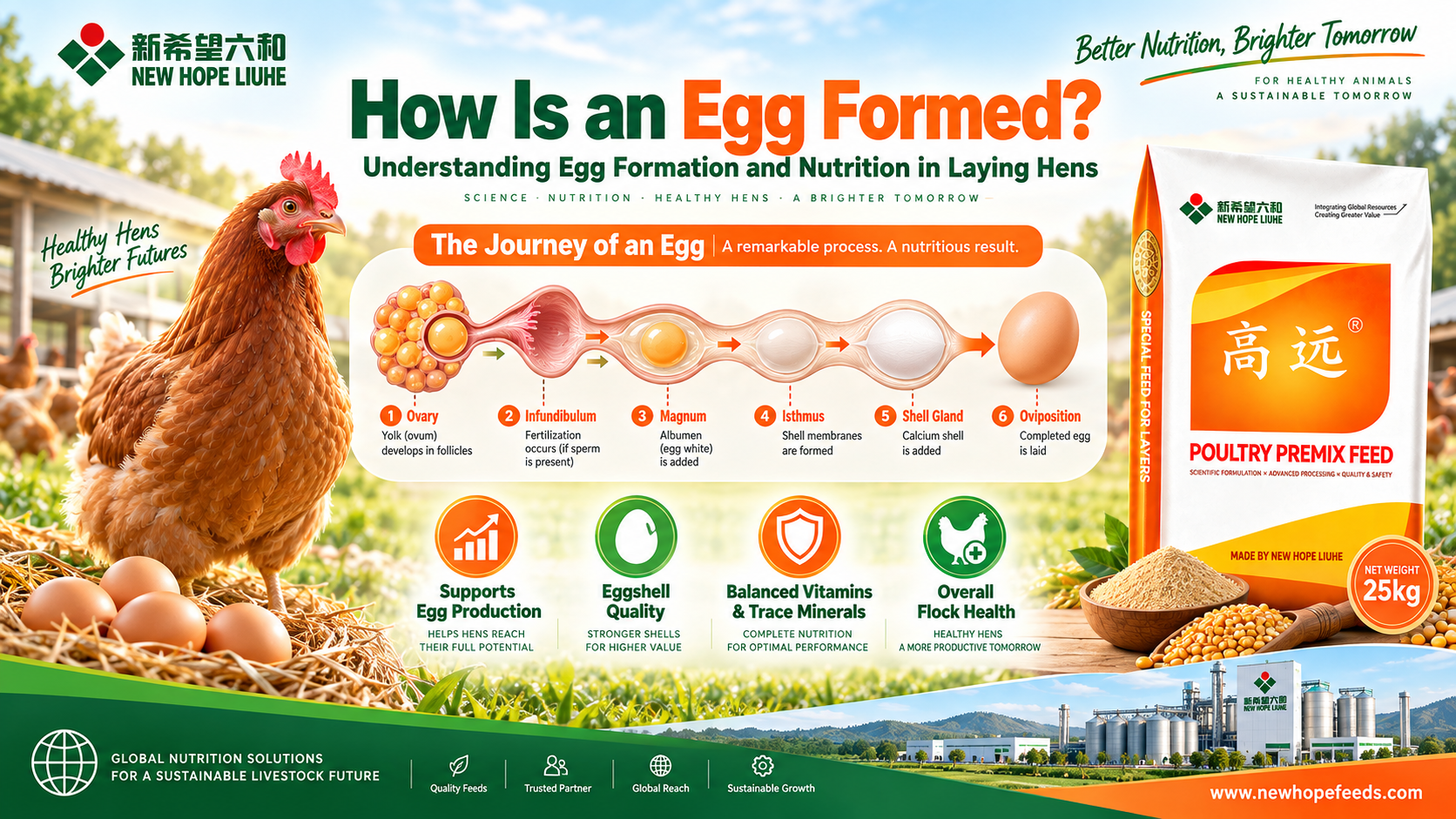
Let us follow the journey of an egg through the reproductive tract.
1. Ovary: Where the Yolk Begins
Egg formation starts in the ovary.
A laying hen has many developing follicles at different stages of maturity. The largest mature follicle contains the yolk that will eventually become part of the next egg.
When ovulation occurs, the mature yolk is released from the ovary.
At this stage, the quality of the yolk is already influenced by the hen's overall nutritional status.
Energy, protein, essential fatty acids, vitamins and trace minerals all contribute to maintaining normal reproductive function and supporting continuous egg production.
For high-producing layers, nutritional consistency is especially important because the next several follicles are developing at the same time.
2. Infundibulum: The Yolk Enters the Reproductive Tract
After ovulation, the yolk is captured by the infundibulum, the funnel-shaped first section of the oviduct.
The yolk normally remains here for only a short period—roughly 15 to 20 minutes.
In breeder hens, fertilization can occur in this region if viable sperm are present.
For commercial table-egg layers, the egg continues through the reproductive tract without fertilization.
Although this stage is short, efficient reproductive function depends on maintaining healthy birds, appropriate body condition and stable environmental management.
3. Magnum: Egg White Is Added
The yolk then enters the magnum, the longest section of the oviduct.
This is where most of the albumen, or egg white, is deposited around the yolk.
The egg generally spends approximately 2 to 3 hours in this section.
Albumen contains large amounts of protein and water, so adequate dietary protein and a balanced amino acid supply are important to overall egg formation.
Methionine, lysine and other essential amino acids must therefore be considered as part of the complete feed formulation.
However, more protein does not automatically mean better egg production.
The goal is to provide a balanced nutrient profile that matches the bird's age, production level, genetics and feed intake.
4. Isthmus: Shell Membranes Are Formed
Next, the developing egg moves into the isthmus.
During this stage, the inner and outer shell membranes form around the albumen.
The egg usually remains here for approximately one to one and a half hours.
These membranes form an important structural layer beneath the eggshell.
Good egg quality therefore depends not on one single nutrient, but on the interaction between protein nutrition, mineral metabolism, vitamins, trace minerals and overall flock health.
5. Uterus or Shell Gland: The Eggshell Is Built
The egg then enters the uterus, also known as the shell gland.
This is the longest part of the egg-forming process.
The developing egg may spend approximately 18 to 20 hours here while the hard shell is formed.
The eggshell consists mainly of calcium carbonate, which means calcium metabolism becomes especially important during this period.
A laying hen must obtain calcium from both:
dietary calcium, and
temporary calcium reserves in the skeleton.
This is why layer diets require careful management of:
calcium
available phosphorus
vitamin D3
mineral balance
particle size and calcium source
feeding time
daily feed intake
If calcium supply or utilization is inadequate, shell quality may be affected.
Possible production signs can include:
thin shells, weak shells, increased cracked eggs or reduced shell strength.
But calcium alone does not determine eggshell quality.
Several trace minerals also participate in shell formation and structural integrity.
For example, manganese, zinc and copper play roles in enzyme systems and tissue development related to egg and shell formation.
Vitamin D3 is especially important because it supports normal calcium and phosphorus metabolism.
This is one reason why a properly designed vitamin and mineral premix is an important component of a commercial layer feeding program.
6. Vagina and Oviposition: The Egg Is Laid
Once shell formation is complete, the egg moves through the vagina and is laid through the cloaca.
At this point, the hen has completed a process lasting around one full day.
Then the cycle begins again.
For a high-performing commercial layer, this means the reproductive and nutritional system is working continuously.
That is why layer nutrition must be designed for consistency, not occasional supplementation.
Why Eggshell Quality Is More Than Just Calcium
One of the most common mistakes in layer nutrition is to assume:
“Poor shell quality means we simply need more calcium.”
The reality is more complicated.
Eggshell quality can be influenced by many factors, including:
hen age
genetics
calcium intake
phosphorus balance
vitamin D status
trace mineral supply
feed intake
heat stress
water intake
disease challenge
gut function
feed particle size
laying cycle stage
For example, older laying hens generally produce larger eggs, while the amount of shell material does not necessarily increase proportionally.
As a result, maintaining shell strength may become more challenging later in the laying cycle.
A professional feeding program therefore considers the whole nutritional system, rather than focusing on one mineral alone.
The Role of Vitamins and Trace Minerals in Layer Performance
Vitamins and trace minerals are required in relatively small quantities compared with energy and protein, but they participate in many essential metabolic functions.
Important micronutrients in layer nutrition include:
Vitamin D3
Supports calcium and phosphorus metabolism and therefore plays an important role in skeletal and eggshell mineralization.
Vitamin A
Supports normal epithelial tissues, reproductive function and general physiological health.
Vitamin E
Functions as an antioxidant and contributes to normal immune function.
B Vitamins
Participate in energy, protein and metabolic pathways required for normal production.
Manganese
Participates in several enzyme systems and is associated with skeletal and eggshell development.
Zinc
Supports enzyme activity, tissue integrity and normal physiological functions.
Copper
Participates in connective tissue formation, enzyme activity and mineral metabolism.
Because these nutrients interact with one another, formulation accuracy is important.
Simply adding more of one nutrient does not guarantee better performance.
Why Premix Quality Matters
Premix may represent only a relatively small percentage of the complete feed formula, but it carries a concentrated package of micronutrients.
For feed mills, integrators and commercial farms, a good premix program should consider more than the ingredient list.
Important factors include:
nutrient specification
raw-material quality
mixing uniformity
stability
inclusion rate
feed formulation
species and production stage
local raw materials
target performance
This is why two products both labeled “Layer Premix” may perform very differently.
The correct question is not simply:
“How much does the premix cost?”
A better question is:
“What nutrition specification does this premix provide in my complete feed?”
Layer Nutrition Should Match the Production Stage
The nutritional requirements of a pullet are different from those of a hen at peak production.
Likewise, a layer at the beginning of production may have different nutritional priorities compared with an older flock.
A professional layer program may therefore consider different nutritional solutions for:
chick development
pullet growth
pre-lay
early laying
peak production
post-peak production
late laying period
The objective is to maintain appropriate nutrient supply as feed intake, egg mass, body weight and shell demands change.
New Hope Liuhe Layer Premix Solutions
At New Hope Liuhe, we provide premix and animal nutrition solutions for feed mills, distributors and livestock producers in international markets.
Our layer nutrition portfolio includes solutions designed for different production stages.
For example, our 5% Layer Production Compound Premix is intended for the egg production period and can form part of a complete layer feeding program.
Depending on the customer's production system, raw materials and target performance, our nutrition team can also support:
Customized formulation
Vitamin and mineral premix solutions
Core premix solutions
Technical specification review
COA and product documentation
Existing formula comparison
Premix testing and evaluation
The final inclusion rate and formulation should always be selected according to the specific feed formula, raw-material profile and nutritional objectives of the customer.
Better Eggs Begin With Better Nutrition
Every egg represents more than 20 hours of coordinated biological activity.
From follicle development to albumen formation and shell mineralization, the laying hen continuously converts nutrients into a highly structured biological product.
That is why successful layer nutrition is not simply about adding calcium or increasing protein.
It requires balance.
Balanced energy.
Balanced amino acids.
Balanced vitamins.
Balanced minerals.
And a feeding program designed around the bird's production stage.
Understanding how the egg is formed helps us understand why precision nutrition matters.
At New Hope Liuhe, our goal is to work with feed manufacturers, distributors and poultry producers to develop practical nutrition solutions for sustainable layer performance.
Better Nutrition. Brighter Tomorrow.
For Layer Premix, Core Premix or customized poultry nutrition solutions:
Website:www.newhopefeeds.com
Email:qixin5@newhope.cn
WhatsApp: +86 182 0017 3019